
This article is translated from the Chinese original.
1. The basic idea of SNI
Imagine a members-only restaurant building:
- There are many different restaurants inside the building (multiple websites)
- SNI is like your reservation information (“I am going to restaurant xx”)
- The front desk uses that reservation to guide you to the right restaurant
graph TB subgraph "Members-only restaurant building (server)" A[Front desk<br/>server reception] -->|SNI info| B[Restaurant 114] A -->|SNI info| C[Restaurant 514] A -->|SNI info| D[Restaurant 1919] end E[Visitor<br/>client] -->|Tells the reservation target<br/>SNI info| A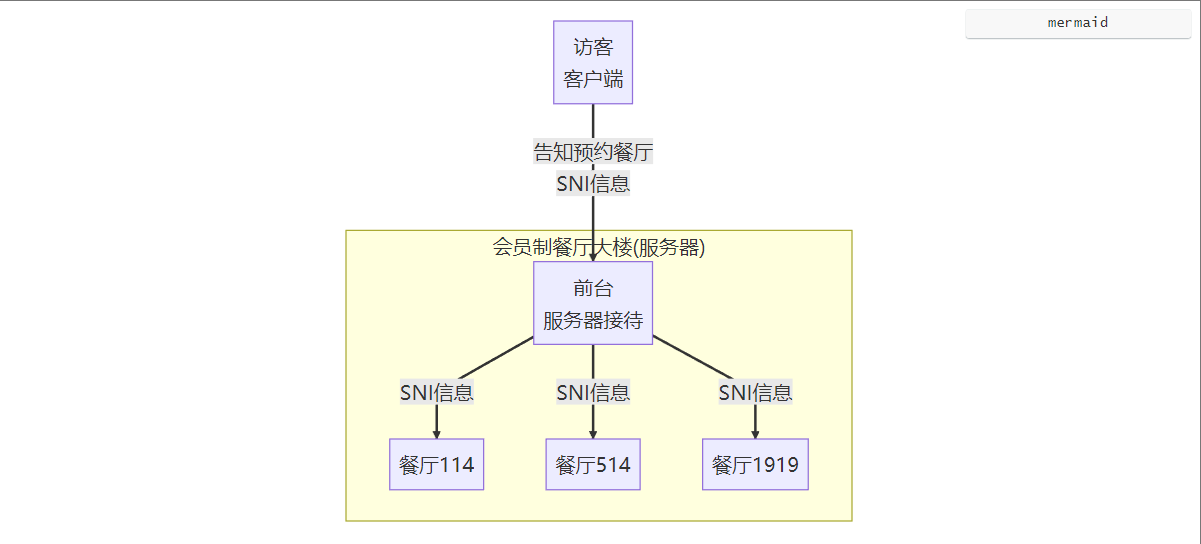
2. Normal proxy flow
Think of it like this: you want to reach a place that can only be accessed through tunnels (the target site), so you hire a local guide (the proxy VPS) to help you get there.
sequenceDiagram    participant C as You (client)    participant P as Guide (proxy VPS)    participant T as Destination (target site)
    Note over C,T: A normal proxy flow is like asking a guide to lead the way    C->>P: 1. Find the guide (establish connection)    C->>P: 2. Tell the guide the code word (SNI)    P->>T: 3. The guide takes you to the destination    T->>P: 4. Gets the resource    P->>C: 5. Hands it to you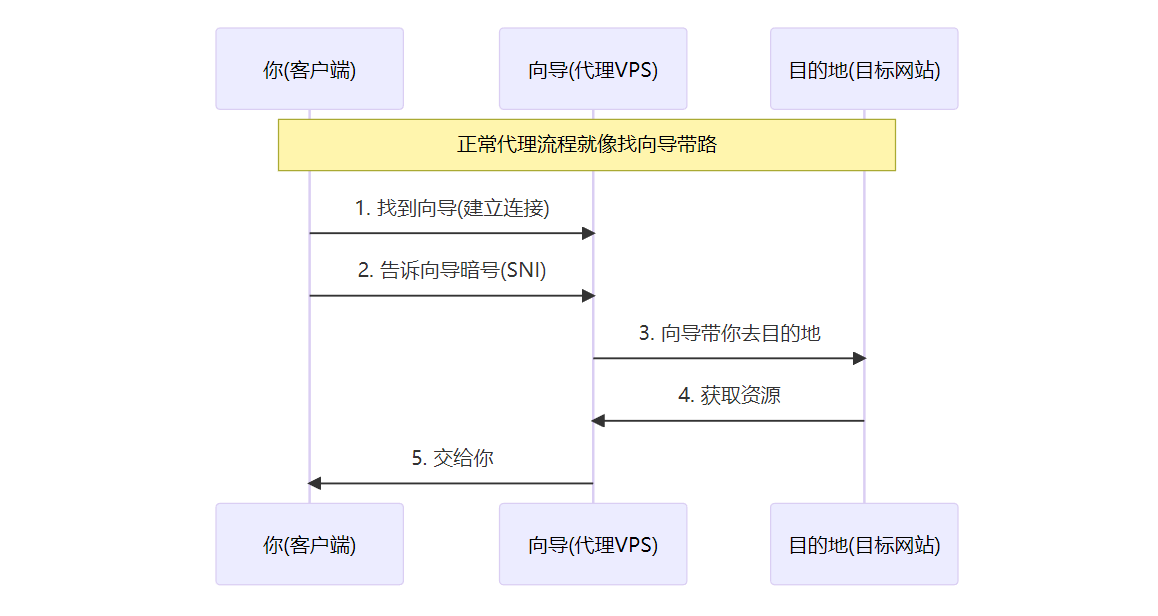
3. Cloudflare hijacking flow
Now imagine that your guide works at a transit station called Cloudflare, so everyone has to check in there first.
graph LR    subgraph "Full flow (double the trip)"    A[You<br/>client] -->|1. Go to the transit station first| B[CloudFlare<br/>transit station]    B -->|2. Pass through to the guide| C[Proxy VPS<br/>guide]    C -->|3. Has to go back to the station| B    B -->|4. Only then reaches the destination| D[Target site]    end
    style B fill:#ff9,stroke:#333,stroke-width:4px    style C fill:#bbf,stroke:#333,stroke-width:4px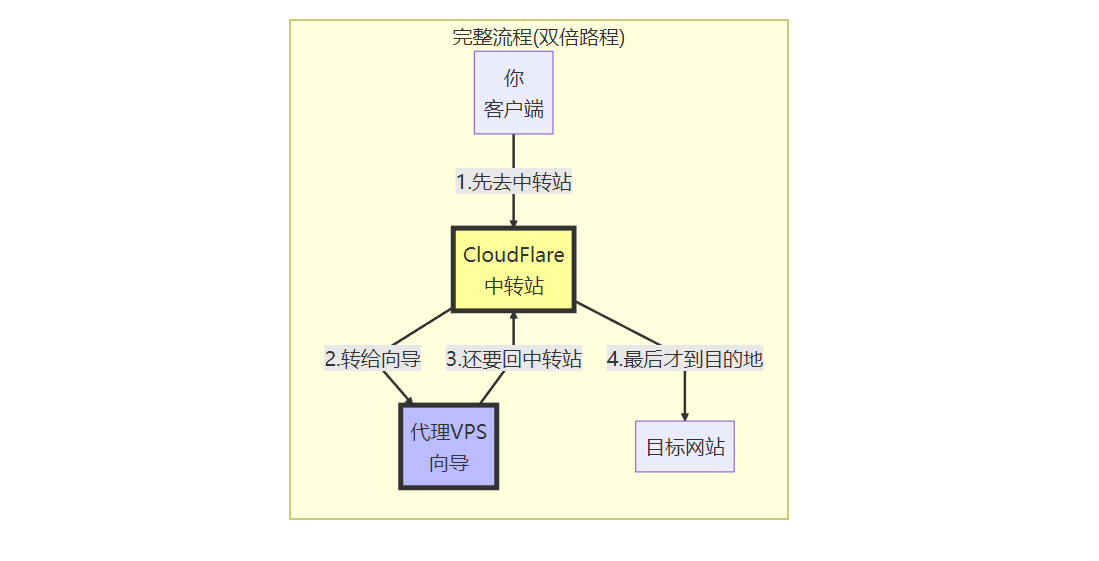
3.1 Traffic cost explanation
It is like a place that used to take only one trip to reach:
- Now you must report to the transit station first
- Then go from the transit station to the guide
- Then the guide has to bring you back to the transit station
- Only after that can you reach the final destination
As a result:
- The guide has to travel twice the distance (proxy VPS traffic doubles)
- The route becomes longer (higher latency)
- The cost increases (more bandwidth expense)
4. The SNI disguise mechanism
SNI disguise is like:
- You hold a special “passport” (SNI)
- On the surface it says you are going somewhere ordinary, such as
microsoft.com - In reality it is a code used to pass through a special channel
graph TB subgraph "SNI disguise mechanism" A[Your request] -->|Looks like it is going to Microsoft| B{Proxy server} B -->|Actual destination| C[Real website] end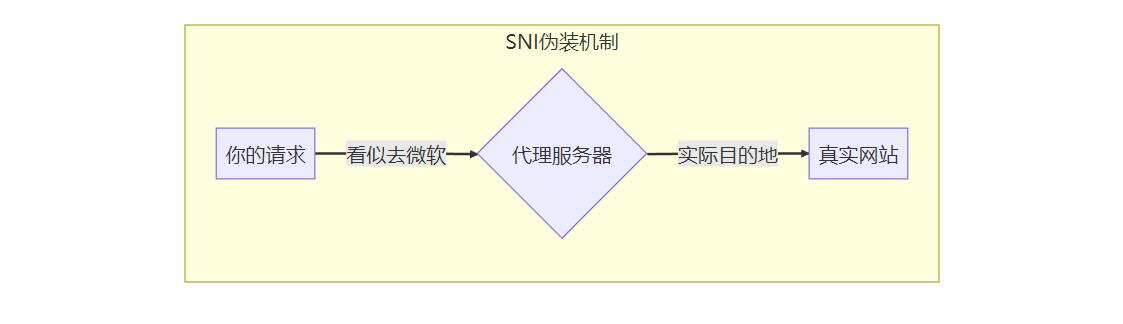
5. Why does Cloudflare hijack the traffic?
Imagine Cloudflare as a mandatory checkpoint:
- If you use their label (a Cloudflare domain)
- Then all related traffic must pass through them for inspection
- It cannot take another direct path
sequenceDiagram    participant C as Client    participant CF as CloudFlare (mandatory checkpoint)    participant V as Proxy VPS (guide)    participant T as Target site
    Note over C,T: The result of using a Cloudflare domain    C->>CF: 1. Must be checked first    CF->>V: 2. Passed on to the guide    V-->>T: 3. Tries to go directly to the destination (fails)    V->>CF: 4. Forced back to the checkpoint    CF->>T: 5. Delivered by the checkpoint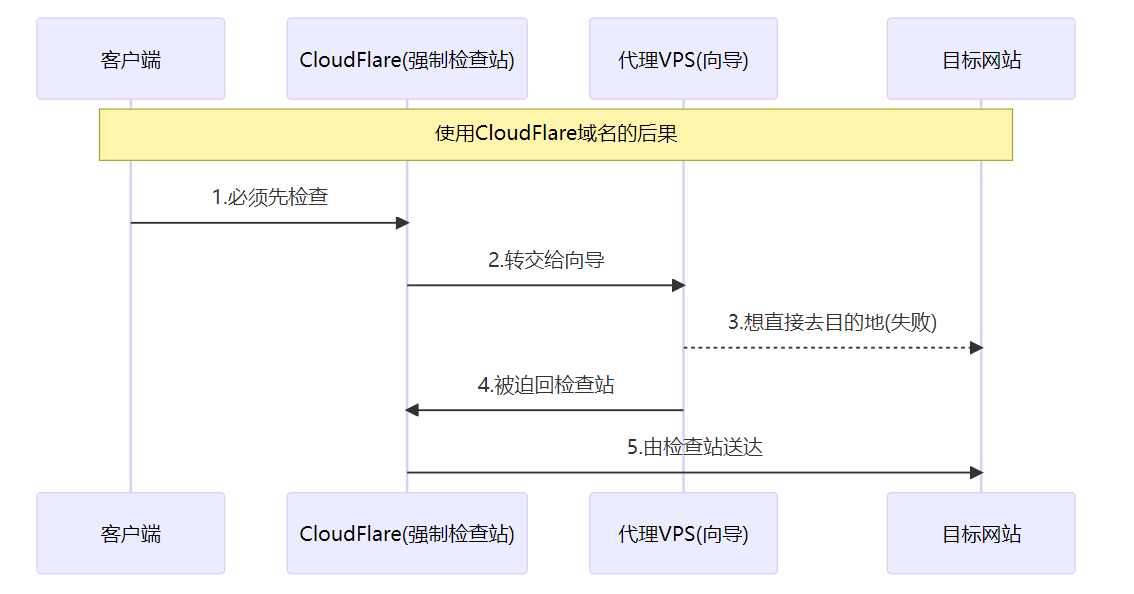
6. Best practice suggestions
To avoid this situation, you should:
- Use a domain that is not proxied by Cloudflare
- Or use direct IP connections
- Avoid unnecessary relays
graph TB    subgraph "Correct configuration"    A[Client] -->|Contact directly| B[Proxy VPS]    B -->|Access directly| C[Target site]    end
    subgraph "Incorrect configuration"    D[Client] -->|Forced relay| E[CloudFlare]    E -->|Extra path| F[Proxy VPS]    end
Core takeaways
- SNI is the “reservation information” for accessing a website
- A proxy service is like asking a “guide” to lead the way
- A Cloudflare domain can force traffic to take a detour
- That detour doubles the traffic consumption
- Choosing the right SNI helps avoid these problems